Annual Reports
Molina Healthcare, Inc.'s annual reports contain management's most considered account of the business. These are the sections, passages and visual pages worth opening in the originals preserved in Sources.
Molina Healthcare, Inc. — FY2025 Annual Report (Form 10-K) — FY2025
The latest 10-K: management's account of a hard 2025 — record revenue, but a sharp margin and earnings decline as medical costs outran rates. · Open the full document →
Item 1. Business — p. 7 · Read the full section →
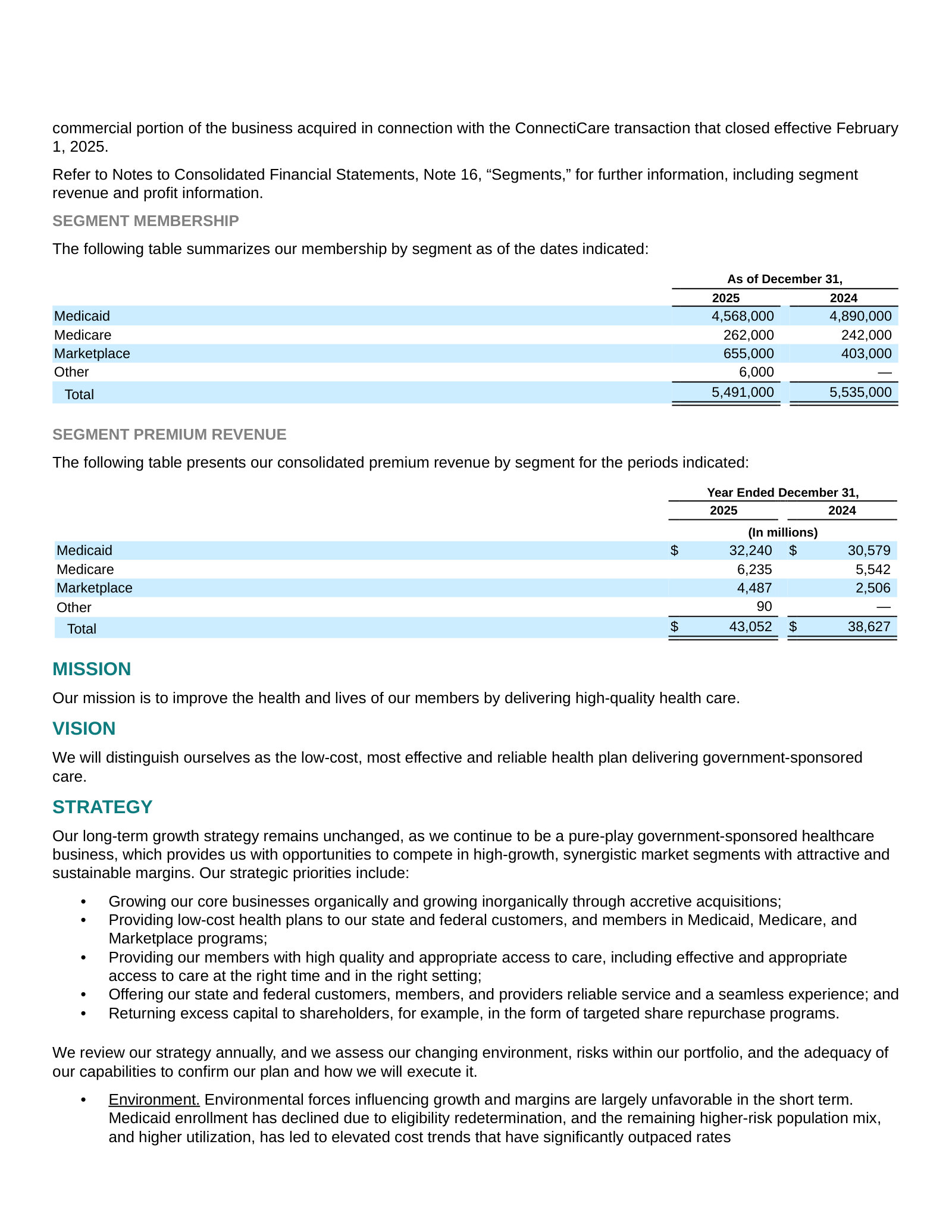
How Molina earns: fixed government premiums across four programs — Medicaid, Medicare, Marketplace — for 5.5M members in 21 states.
Item 1. Business — Trends and Uncertainties — p. 23 · Read the full section →
The regulatory forces reshaping the near-term earnings base: OBBBA Medicaid cuts and the 2025 expiration of Marketplace subsidies.
Management sizes OBBBA: a 15–20% cut to 1.2M Medicaid Expansion members by 2029, plus Marketplace enrollment pressure.
The President signed the OBBBA into law in July 2025, which contains changes to the Medicaid and Marketplace programs. […] We currently estimate the reduction in enrollment will be in the range of 15% to 20% by 2029 on 1.2 million members in our Medicaid Expansion population, and any acuity shifts should be modest and gradual. […] The law limits which legal aliens may be eligible for Marketplace PTCs and will require pre-enrollment eligibility verification for enrollees to receive PTCs. These changes are planned to be phased in over the period from 2026 to 2028 and are expected to reduce national Marketplace enrollment as well.
p. 23 · Read in context →
Item 1A. Risk Factors — p. 39 · Read the full section →
The two risks that actually bite this insurer: state rates lagging cost trend, and a volatile Marketplace book that is hard to price.
Core margin risk: premiums are fixed by contract and reset only annually, so when costs outrun rates the medical margin compresses.
Our premium revenues consist of fixed monthly payments per member, and supplemental payments for other services such as maternity deliveries. These premiums are fixed by contract, and we are obligated during the contract periods to provide healthcare services as established by the state governments in which our health plans operate. Rate increases are most typically implemented by states on only an annual basis. We use most of our premium revenues to pay the medical costs of healthcare services delivered to our members. If the premiums paid to us are not increased at a rate that is commensurate with the rate at which medical expenses related to healthcare services rise, or the rate at which health care utilization rates increase, our medical margins will be compressed or eliminated, and our earnings will be negatively affected.
p. 39 · Read in context →
Marketplace is price-sensitive and volatile — and the APTC subsidies most members relied on expired at the end of 2025.
Marketplace plan selection by members is highly price sensitive, and the Marketplace markets in general are highly volatile and unpredictable from year to year. In recent years, most of our Marketplace members were eligible to receive government-subsidized premium subsidies. Even though certain advanced premium tax credits (“APTCs”) expired at the end of 2025, it is possible that they could be renewed, but the timing of such a decision, and the manner in which they could be renewed, is uncertain.
p. 39 · Read in context →
Item 7. Management's Discussion and Analysis — p. 77 · Read the full section →
Where management explains the 2025 miss: operating income more than halved as the medical care ratio rose across every segment.
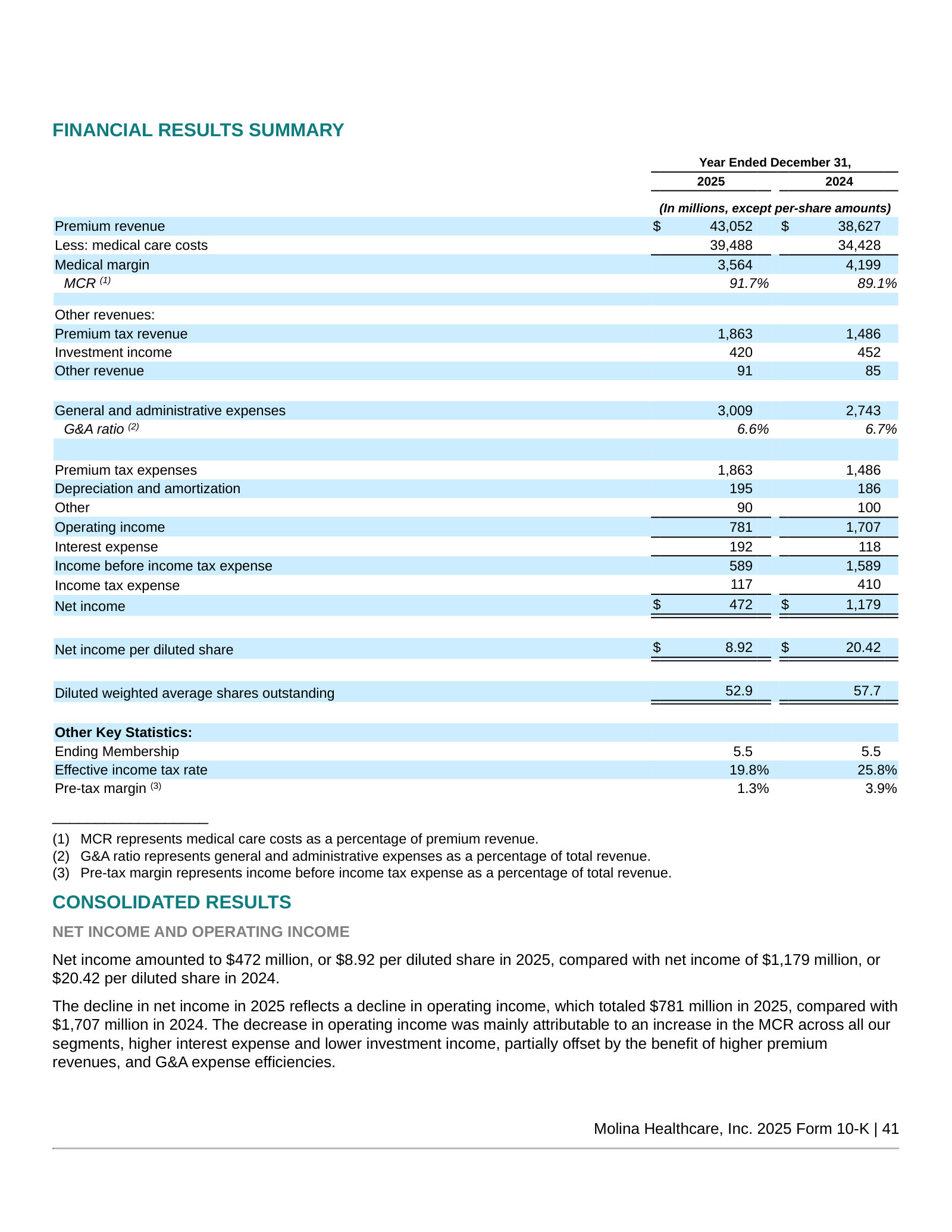
2025 result: net income fell to $472M from $1,179M, driven by a higher MCR across all segments.
Net income amounted to $472 million, or $8.92 per diluted share in 2025, compared with net income of $1,179 million, or $20.42 per diluted share in 2024. […] The decrease in operating income was mainly attributable to an increase in the MCR across all our segments, higher interest expense and lower investment income
p. 78 · Read in context →
Critical Accounting Estimates — p. 92 · Read the full section →
The estimate that defines a managed-care insurer: IBNP, the reserve for claims incurred but not yet paid, and the auditors' critical matter.
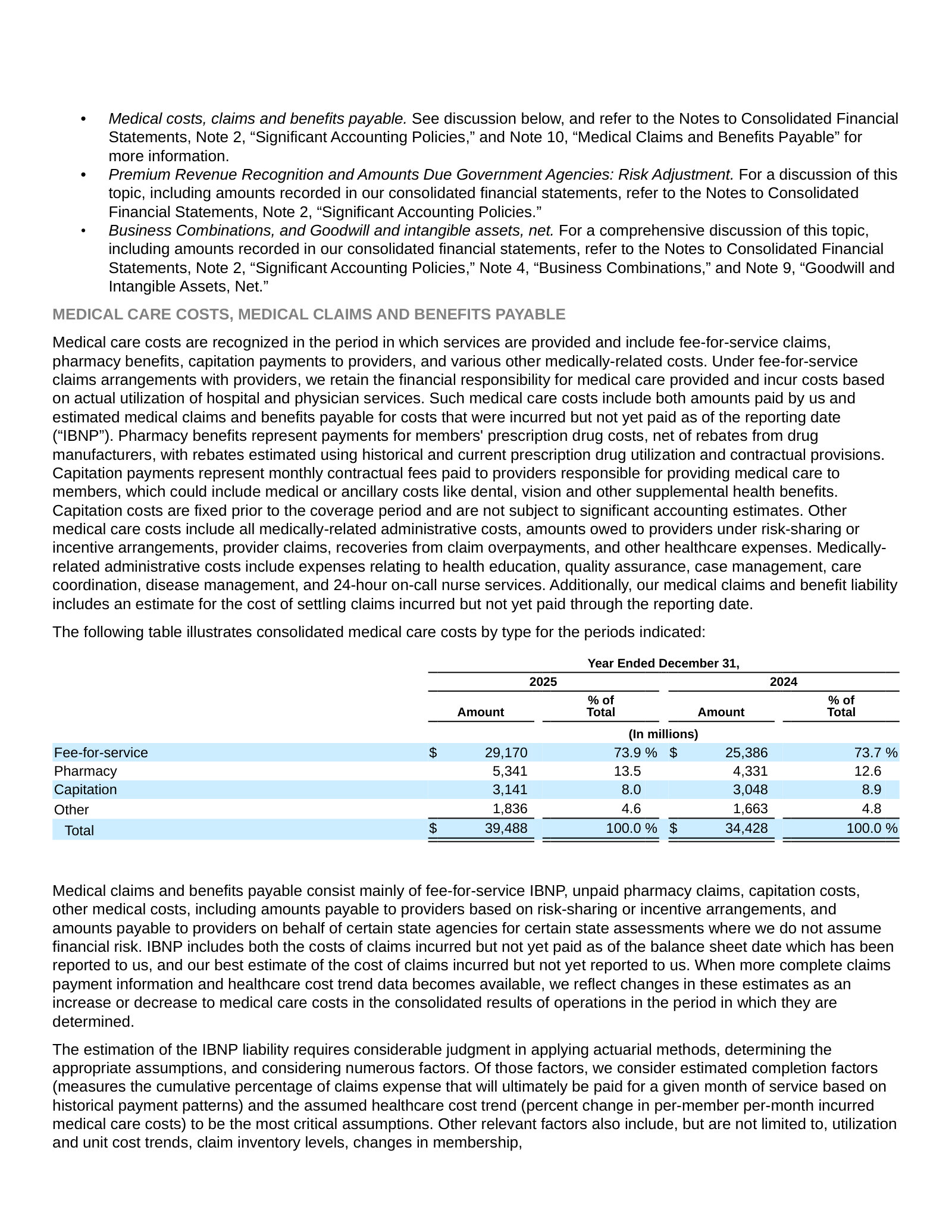
How medical care costs and the IBNP reserve are recognized — the judgment at the heart of every quarter's result.
Medical care costs are recognized in the period in which services are provided and include fee-for-service claims, pharmacy benefits, capitation payments to providers, and various other medically-related costs. Under fee-for-service claims arrangements with providers, we retain the financial responsibility for medical care provided and incur costs based on actual utilization of hospital and physician services. Such medical care costs include both amounts paid by us and estimated medical claims and benefits payable for costs that were incurred but not yet paid as of the reporting date (“IBNP”).
p. 94 · Read in context →
Molina Healthcare, Inc. — FY2021 Annual Report (Form 10-K) — FY2021
Featured for one section: the first 10-K under the four government-program segments Molina still reports today. · Open the full document →
Item 1. Business — Our Segments — p. 7 · Read the full section →
Sees the pivot itself — the Q1 2021 realignment to programs (Medicaid/Medicare/Marketplace/Other) that frames every report since.
The Q1 2021 realignment to Medicaid, Medicare, Marketplace and Other segments — the reporting structure still in use.
In the first quarter of 2021, we realigned our reportable operating segments to reflect recent changes in our internal operating and reporting structure, which is now organized by government program. These reportable segments consist of: 1) Medicaid; 2) Medicare; 3) Marketplace; and 4) Other.
p. 7 · Read in context →
More annual reports
Molina Healthcare, Inc. — FY2024 Annual Report (Form 10-K) — FY2024 · 155 pages · The prior-year peak the FY2025 decline is measured against — full-year results at an 89.1% MCR before margins compressed. · Open →
Molina Healthcare, Inc. — FY2023 Annual Report (Form 10-K) — FY2023 · 151 pages · Covers the post-pandemic Medicaid redetermination wind-down and the Bright Health California Marketplace acquisition. · Open →
Molina Healthcare, Inc. — FY2022 Annual Report (Form 10-K) — FY2022 · 142 pages · First full year under the four-program segments, absorbing the AgeWell, My Choice Wisconsin, Cigna and Affinity acquisitions. · Open →